This is a vocabulary and conversation lesson for C1/C2 students. Students look at 18 animal idioms and put them into practice in conversation and an optional writing exercise. Download the handouts below:
This is a loooong worksheet for students preparing to take the C1 Advanced exam, it has 82 key word transformation questions. I’ve basically just taken this great quizlet set and copy pasted it into a Google Doc, but it took a while so hopefully it’ll save you some time. Download the handout and answer key below:
I have a group who are taking the exam in 3 weeks so they want lots of practice, so I gave them this sheet with 78 expressions on it to study on Monday and told them to study it. Now I’m going to have them do the first 1/3 of the test in class today (Wednesday).
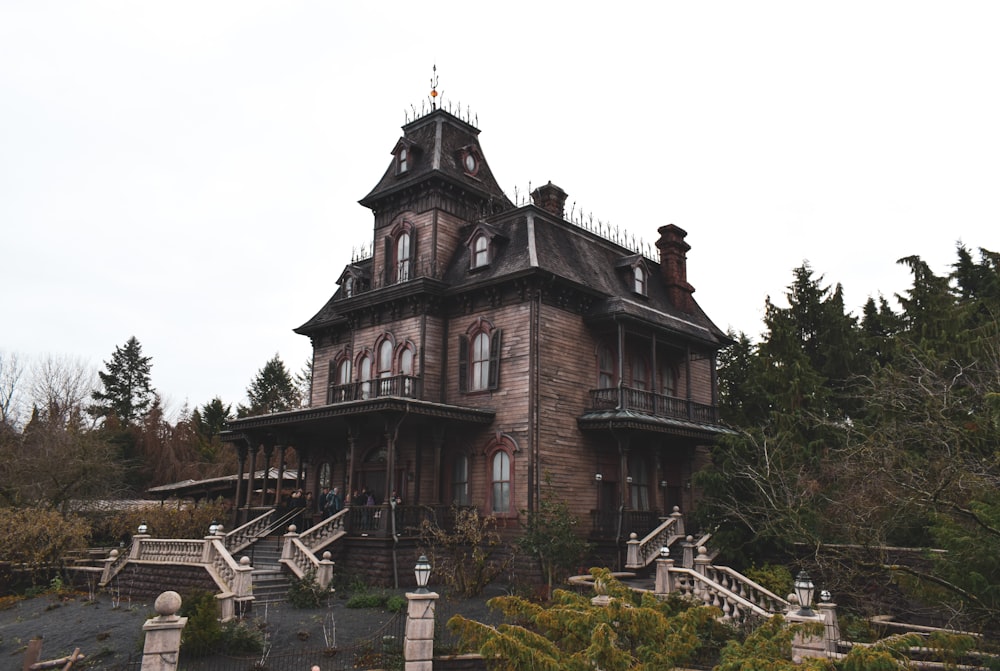
This is a lesson plan for C1/C2 students who are preparing for an upcoming exam but still want to celebrate Halloween in some way. Students read a creepy story about an old family home, practice some word formation and then write their own continuation of the story. I wrote the story myself, let me know what you think! Download the handout and teacher’s notes below:
You’re going to read the first part of a horror story called “The Family Legacy”, it involves:
A father
A son
An old house
With your partner, make some predictions about what will happen in the story.
Reading
Read the story, ignore the gaps, see if your predictions were correct.
Roger trudged up the drive of the ancient hall, the seat of his family’s power for over two centuries. It stood on the top of the hill looking down over the land around, a 1. ………………(SYMBOL) effigy of the family’s grasp over the local 2. ……………. (POPULATE). Finally it was his, the jewel in the crown of his 3. ……………… (INHERIT) after his father’s passing the previous week. In the end, the death of the formidable patriarch of the family had been far from the 4. ……………… (PAIN) transition we all hope for, screaming night terrors, lashing out 5. ……………… (VIOLENT), catching his 6. ………………(SUSPECT) carers off-guard, until the final descent into silent 7. …………… (MAD) It was something that had befallen the last three generations of men in his family, a thought that he pushed to the back of his mind as a/an 8. ………………. (VOLUNTEER) shudder ran down his spine.
But it was over, and he could now envisage the 9. …………….. (REALISE) of all the 10. ……………… (BOY) hopes and dreams he had had for this 11. ……………….. (CRUMBLE) pile of stone and wood. As he approached the ancient 12. ………………..(WOOD) door, he took the old iron key from his pocket and unlocked it with a 13. ……………….. (SATISFY) thunk. As he stepped across the threshold his 14. ……………….. (FOOT) echoed throughout the house in a/an 15. ……………….. (SETTLE) way. What struck Roger immediately were the reminders of his father’s 16. ……………….. (QUESTION) taste in decorations; floor to ceiling oil paintings of 17. ……………….. (NOTE) ancestors and the heads of various animals mounted on the walls. He relished the thought of finally 18. ……………….. (CLUTTER) the whole place. No sooner had this thought crossed his mind than around the corner came an almost 19. ……………….. (PERCEIVE) breath of air, which flowed through the ground floor, as if the house itself was reacting to a/an 20. ……………….. (INVITATION) guest. The door slammed shut behind Roger, he heard a loud “clang” as the heavy old key hit the stone of the porch outside. Suddenly gripped by panic he grabbed the door handle and pulled with all his 21. ……………….. (STRONG) but to no avail. A sudden sense of 22. ……………….. (CONFINE) enveloped him, but what really set his nerves jangling and a creeping sense of 23. ……………….. (EXIST) dread curling up his back was the voice calling down the stairs from his father’s study….
Word Formation
Now look at the gaps, try to predict what type of word is needed, then attempt to transform the root words to fit the context.
Language Analysis
How does the writer make the story creepy?
Find two examples of onomatopoeia in the text.
Find and underline the sentence with “around the corner”
What do you notice about the syntax?
Look for impressive collocations with the following words:
Power…………………………………………Grasp…………………………………………Jewel…………………………………………Patriarch…………………………………………Catching…………………………………………Madness…………………………………………Mind…………………………………………Spine…………………………………………Hopes and dreams……………………………
This is a guest post by Soleil García Brito just in time for Halloween. This lesson plan is for C1 students. They will discover the spooky origins of the jack-o-lantern and then learn about the new phenomenon of “spoopy” by doing a gapped text reading exercise. Download the handout and teacher’s notes below:
Watch the video (x2) until 5:17 and fill the gaps (1 to 3 words):
Once you think about the name “Jack-o’-lantern”, it becomes evident that this tradition comes from ____________.
Stingy Jack’s personal qualities made the devil ____________.
On his way home Jack saw _______________ on the ground.
The mutilated corpse’s voice was _____________ Satan himself.
The devil was surprised by Jack’s ______________.
Jack prevented the devil from climbing down the tree by surrounding it with ___________.
The devil gave Jack a glowing ember as a _____________.
According to the legend, Jack walks around _____________________ on October 31st.
Reading and Use of English (Part 7)
Read the text and choose the correct paragraph from [A]-[G] to fill in the gaps [1]-[6]. There is one extra paragraph, which you do not need to use.
ADAPTED FROM CULTURE DESK – San Francisco Chronicle
What is spoopy? Your guide to the Internet’s favorite Halloween aesthetic
For the past few years, October has not only heralded the return of Halloween and pumpkin spice lattes, it has also marked the dawning of spoopy season. For a small group of people who belong in the center of a Venn diagram of mellowed-out goths and the “extremely online,” the spoopy aesthetic has become a source of joy and comfort in turbulent times.
[1]
“Spookiness is campy, but spoopiness is campy in a very specific way,” says John Paul Brammer, a New York City writer and advice columnist whose popular memes about the demonic goat from the movie “The Witch” are more of the former. “Spoopy’s whole thing is that it is not frightening. It’s not threatening, not arcane, but uses the trappings of the threatening and the arcane to make the joke: OoOoOooOo!!! SpoooOOoooOOooky!!”
[2]
Its origin is much more straightforward than its meaning. In 2009, the word was spotted on a skeleton-theme sign displayed at a Ross Dress For Less store. Though its ascent took some time, the term gained popularity on niche social media communities like Tumblr until it finally reached escape velocity to spread even further.
[3]
Though it might seem random, the delight of this sort of banal creepiness stems from the desire to look an object of fear in the eye — and laugh.
[4]
In political discourse, Prevas points to anti-transgender activists using the image of Frankenstein’s monster to demonize transgender people. Historically, monsters have often stood in for types of people who were undesirable: racial minorities, immigrants, queer people, anyone outside the “normal.” “I love the unsettling part of (spoopiness),” Prevas says, “that disconnect between seeing the creatures which we expect to see in a horror scenario in a perfectly quotidian scene.”
[5]
I don’t think it’s a coincidence that it resonates so well right now, at a time when marginalized people’s status feels extremely fraught and political rhetoric insists on estranging us from polite society. This aesthetic defies the imperative to be afraid: Instead, we embrace the monsters as part of ourselves, as neighbours. To let the monster out is, in a sense, letting oneself out.
[6]
When we look at the skeleton riding a bike, it almost feels aspirational: This is what life could look like if our cloistered selves were set free. As it turns out, spoopiness might be just what we need right now.
[A] Because I’m a restaurant critic, my gauge of whether or not something has hit the mainstream is “The Great British Bake-Off.” In the 10th season, currently airing on the British Channel 4 and Netflix, Spanish contestant Helena Garcia has emerged as a fan favourite thanks to her memorably macabre but cute creations like a chocolate orange tarantula flanked by macadamia nut spider eggs, eldritch horror pies and bloody green “witch finger” biscuits.
[B] What is “spoopy”? It’s the coupling of wildly absurdist humour with terror — an aesthetic unto itself that, like camp, can be hard to articulate.
[C] Spoopy is a reclamation and reframing of these monsters, a mind-set that boasts, “You say I should be scared of this? Hilarious!”
[D] In fables and literary fiction, monsters are the embodiments of everything that society represses: a “warning system” of sorts, says Christine Prevas, a Columbia University Ph.D. candidate whose research focuses on applying queer theory to contemporary horror. The monster is a taboo made flesh: A prepubescent girl turned foul-mouthed, vomiting demon in “The Exorcist”; a bad sexual encounter run amok in “It Follows.”
[E] When I look at this stuff, it reminds me of how I like to “watch” horror movies by reading their plot summaries on Wikipedia: a digital version of peeking at Medusa’s face by holding up a mirror.
[F] This disruption of the narrative of otherness mirrors the way people actually want to be seen. For instance, queer people can be queer outside of designated contexts like gay bars and the privacy of one’s bedroom, Prevas says. “We’re also queer in the grocery store. We’re also queer on a bicycle.”
[G] Much easier than defining it is sorting through what is and isn’t spoopy. As a start, think of it as friendly and somewhat sarcastic horror: A skeleton isn’t, but a skeleton riding a bike? Definitely spoopy. The Babadook isn’t, but the memes that claim that the monster is a proud gay man? Super spoopy.
Language focus (15 min)
Vocabulary
Look at the words in bold in the text and discuss the meaning with a partner:
Former
Somewhat
Spotted
Gauge
Embodiments
Unsettling
Mirrors
Next, fill in the gaps with the vocabulary words in the correct form to fit the context:
Jack saw a mutilated corpse with a(n) _____________ look on its face.
His mood ___________ the gloomy weather on that Halloween night.
Between risking being tricked and facing Jack’s grumbling stomach for the rest of the trip, the devil chose the _________.
Some consider him the very _____________ of evil.
The devil was ____________ confused by Jack’s request to pay the bill at the bar.
Jack ___________ a mutilated corpse on the ground on his way home from the bar.
USEFUL CHUNKS
Use the trappings of (sth) Stem from Run amok In a sense
After Jack __________ the level of danger he was in, he decided to trap the devil by using crosses.
This is another worksheet designed to help introduce students to typical expressions that are tested in part 4 of the reading and use of English paper. Download the handout below:
This is a lesson plan for B2+ students. It is based on a text from https://www.iflscience.com/ on the subject of wild animals. It will serve as good exam practice for students preparing to take Cambridge exams and should also be an engaging topic of conversation for teenagers and adults. Download the handouts and slides below:
Show students the second slide of the PowerPoint, encourage them to guess which animal would win.
Show them the second and have them speculate about how a goat would beat a bear.
Give out handout and have students read to confirm their speculations, check in open class.
Have students complete the open cloze, they could work in pairs or individually and then check with their partner. Good practice for Cambridge exams use of English.
Lead students through the vocabulary exercises.
Discussion: Which animal could you beat in a fight? Show students the fourth slide and explain the statistics to them. Put students in groups and have them discuss which animals they think they could beat and how they would do it.
Lead a discussion on the best way to tackle certain large, dangerous animals. Have students speculate on the best thing to do in each encounter, then check on the internet to see whether or not they would have survived. Board any emergent language and exploit it for recall later.
Open Cloze Key
Apex predators make (1) IT to the top (2) BY being the most efficient hunters in their domain, but every now and (3) THEN an underdog crops up to disrupt the food chain. (4) SUCH an example played out on the mountains of Burgess Pass in Yoho National Park, where Parks Canada retrieved the body of a female grizzly bear. Such a creature would usually (5) BE the slayer rather than the slain, and most surprisingly of all the assailant turned (6) OUT to be a goat.
The battle (7) TOOK place sometime before September 4 after which Parks Canada was made aware (8) OF the presence of a carcass. Bodies such (9) AS these need to be removed as they can otherwise lure in wildlife that could put visitors to the pass (10) AT risk.
The discovery of a slain bear merits a forensic investigation to determine the (11) CAUSE of death, and so a necropsy (12) WAS conducted on the animal. During the examination, staff noticed that the fatal wounds were at the base of the bear’s neck and in (13) ITS armpits. The attack sites might sound random to the uninitiated, but to experienced park rangers, this was the work (14) OF one extremely lucky mountain goat.
“When grizzly bears attack, they tend (15) TO focus (16) ON the head, neck, and shoulders of the prey, usually (17) FROM above,” Alison Biles, Public Relations and Communications Officer for Parks Canada, told IFLScience. “In turn, the defensive response of mountain goats would (18) BE to protect themselves using (19) THEIR sharp horns.”
“Grizzly bear predation of mountain goats is relatively common and significant goat activity was observed (20) IN the immediate area. (21) IN this case, it appears that the mountain goat was (22) TRYING/ABLE to defend itself. While rare, other cases of mountain goats defensively killing bears have (23) BEEN reported in the past, (24) WHICH is not completely surprising since mountain goats are strong animals that are well-equipped to defend (25) THEMSELVES”
Your class has recently taken part in a debate on ways individual citizens can reduce their carbon footprints in order to combat climate change. Below are three of the methods discussed and some quotes from people who took part in the debate.
Changing our diets
Changing travel habits
Changing our shopping habits
Comments:
“Going vegetarian or vegan would be so hard for me, I couldn’t live without meat or cheese!”
“Airplanes and cars pollute so much, I cycle to work and try not to fly too often.”
“Fast fashion is terrible for the planet, people buy cheap clothes and sometimes don’t even wear them!”
Write an essay discussing two of the methods in your notes. You should explain which method you think is most realistic for most people and give reasons to support your argument. You may, if you wish, make use of the opinions expressed in the debate but you should use your own words as far as possible. Write your essay in 220-260 words in an appropriate style.
For episode 52 we spoke to Oscar/Lana Vuli a drag performer based in Barcelona. We spoke about his/her route into drag performance and experiences performing live and on the Youtube Channel “Science Queers”. You’ll find a link to the channel below.
It was a great episode and a really enjoyable interview, we hope you like it!
Thanks to my colleague Natascha Wallace for this idea. Basically it’s a list of advanced expressions, grouped by topic, for C1/C2 students and sets of conversation questions on those same topics. The idea being that they can drop them into their writings or use them in the speaking exam in order to score more points. Alternatively, beyond the world of exams, they will undoubtedly be useful IRL! Download the handouts below:
Have students read the expressions in the first category and try to guess the meaning in pairs. Clear up any doubts in open class.
Ping-pong
Tell students they have 1 minute to try to memorise as many of the expressions in the category as they can. After 1 minute tell them to turn their papers over. Students then play “ping-pong” in pairs one person says one expression and the other must say another back and forth until one can’t remember any more expressions. After they’ve played a couple of rounds tell them to look at the expressions again and refresh their memories of the ones they struggled to remember.
Then hand out the conversation questions and have students discuss them in groups of 3. One member of the group should act as the examiner, asking the questions and also counting the number of killer expressions each person uses. Encourage students to have fun with it and use as many as they can.
Then move onto the next category, rinse and repeat.
There are a lot of categories so you may want to split it over several classes.